

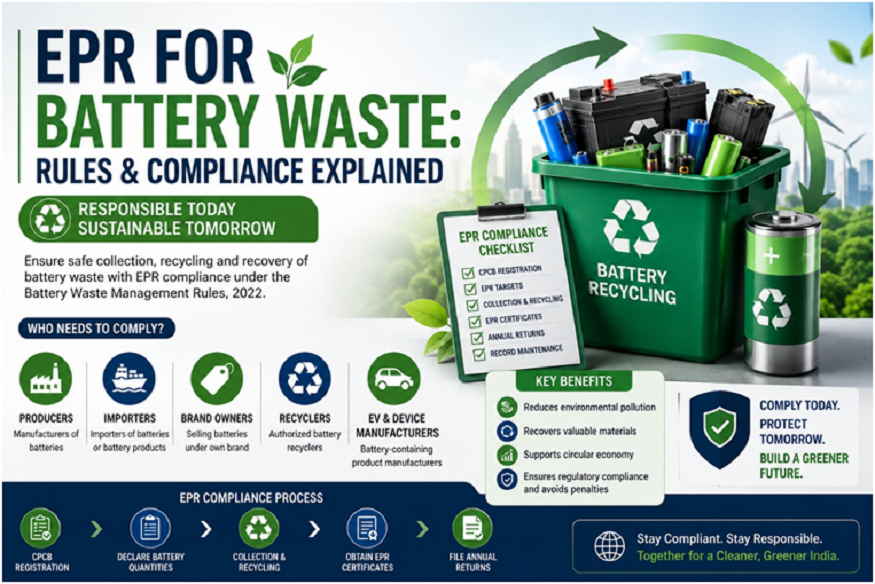
With the rapid growth of electric vehicles, consumer electronics, solar energy systems, and portable devices, battery consumption in India has increased significantly. This has also created a major environmental challenge related to battery waste disposal and recycling. To address this issue, the Government of India introduced the Battery Waste Management Rules, making Extended Producer Responsibility (EPR) mandatory for battery producers, importers, and manufacturers.
Under these rules, businesses dealing with batteries must ensure proper collection, recycling, refurbishment, and disposal of used batteries through authorized channels.
This article explains the key Battery EPR rules, compliance requirements, registration process, and responsibilities businesses must understand.
What Is EPR for Battery Waste?
Extended Producer Responsibility (EPR) for battery waste is a regulatory framework that makes producers responsible for the environmentally sound management of batteries after they reach end-of-life.
The rules aim to:
- Improve battery recycling
- Reduce environmental pollution
- Encourage circular economy practices
- Recover valuable materials like lithium, cobalt, nickel, and lead
- Reduce unsafe disposal of hazardous battery waste
Under the Battery Waste Management Rules, producers are legally responsible for collecting and recycling waste batteries generated from products they introduce into the market.
Battery Waste Management Rules in India
India notified the Battery Waste Management Rules, 2022 to regulate the entire lifecycle of batteries, including:
- Manufacturing
- Import
- Collection
- Refurbishment
- Recycling
- Disposal
The rules apply to all types of batteries regardless of chemistry, volume, weight, material composition, or usage.
Types of Batteries Covered Under EPR
The rules broadly cover:
Portable Batteries
Used in:
- Mobile phones
- Laptops
- Cameras
- Toys
- Power banks
Automotive Batteries
Used in:
- Cars
- Two-wheelers
- Commercial vehicles
Industrial Batteries
Used in:
- Telecom infrastructure
- Data centers
- Energy storage systems
- Industrial equipment
Electric Vehicle (EV) Batteries
Used in:
- Electric cars
- Electric scooters
- Electric bikes
- Electric buses
The inclusion of EV batteries has made EPR compliance especially important for the growing electric mobility sector.
Who Must Comply With Battery EPR Rules?
The rules apply to multiple stakeholders, including:
Producers
Businesses that manufacture or sell batteries under their own brand.
Importers
Companies importing batteries or battery-operated equipment into India.
Brand Owners
Businesses selling batteries under branded labels.
Recyclers &Refurbishers
Authorized entities involved in battery recycling and material recovery.
Manufacturers of Battery-Containing Products
Including:
- Electronics manufacturers
- EV manufacturers
- UPS manufacturers
- Solar equipment suppliers
Key EPR Compliance Requirements for Battery Waste
1. CPCB Registration
All producers, importers, recyclers, and refurbishers must register through the Central Pollution Control Board (CPCB) online portal before carrying out business activities.
Operating without registration may lead to penalties and restrictions.
2. EPR Targets
Producers are required to fulfill annual recycling and material recovery targets based on the quantity of batteries introduced into the market.
The obligations increase progressively over time.
Businesses must ensure that equivalent quantities of waste batteries are:
- Collected
- Recycled
- Refurbished through authorized recyclers
3. Purchase of EPR Certificates
Battery recyclers generate EPR certificates after successful recycling and recovery of materials.
Producers can purchase these certificates to fulfill their EPR obligations.
The certificate mechanism creates a formal recycling ecosystem and improves traceability.
4. Environmentally Sound Recycling
Battery waste contains hazardous materials and must be processed only by authorized recyclers using approved environmental practices.
Improper handling can cause:
- Soil contamination
- Water pollution
- Fire hazards
- Toxic chemical exposure
5. Record Maintenance and Reporting
Businesses must maintain detailed records of:
- Battery sales
- Imports
- Collection quantities
- Recycling certificates
- Waste recovery data
Annual returns and compliance reports must be submitted through the CPCB portal.
Categories of Battery Chemistry Covered
The rules apply to various battery chemistries, including:
- Lithium-ion batteries
- Lead-acid batteries
- Nickel-cadmium batteries
- Nickel-metal hydride batteries
- Sodium-ion batteries
This broad applicability ensures that both traditional and emerging battery technologies are regulated.
EPR Compliance Process for Battery Waste
Step 1: CPCB Registration
Businesses register on the CPCB EPR portal with company and product details.
Step 2: Battery Quantity Declaration
Producers declare the quantity and type of batteries introduced into the market.
Step 3: EPR Obligation Calculation
Annual recycling obligations are calculated based on declared quantities.
Step 4: Collection & Recycling
Waste batteries must be collected and recycled through authorized channels.
Step 5: EPR Certificate Procurement
Businesses purchase recycling certificates from registered recyclers.
Step 6: Annual Compliance Filing
Companies submit compliance reports and maintain supporting documentation.
Common Compliance Challenges
Lack of Collection Infrastructure
Battery collection systems are still developing in many regions of India.
Informal Recycling Sector
A large amount of battery recycling still happens through unorganized sectors without environmental safeguards.
Tracking and Traceability
Businesses often struggle to track battery movement and recovery across the supply chain.
EV Battery Complexity
Electric vehicle batteries involve advanced chemistry and complex recycling requirements.
Regulatory Awareness
Many importers and small businesses are still unaware that battery EPR rules apply to them.
Penalties for Non-Compliance
Failure to comply with Battery EPR Rules may lead to:
- Environmental compensation charges
- Regulatory action
- Business restrictions
- Cancellation of registration
- Legal liabilities
Authorities are increasingly monitoring compliance as battery usage expands rapidly across industries.
Importance of Battery Recycling
Battery recycling provides several environmental and economic benefits:
Recovery of Valuable Materials
Recycling helps recover:
- Lithium
- Cobalt
- Nickel
- Lead
- Copper
This reduces dependence on mining and imports.
Reduced Environmental Pollution
Proper disposal prevents toxic chemicals from entering soil and groundwater.
Support for Circular Economy
Recovered materials can be reused in new battery manufacturing.
Reduced Carbon Footprint
Battery recycling reduces resource extraction and manufacturing emissions.
Why Businesses Use EPR Consultants
Battery EPR regulations involve technical, environmental, and compliance complexities.
Professional consultants help businesses with:
- CPCB registration
- EPR filing
- Obligation assessment
- Recycler coordination
- Certificate procurement
- Documentation support
- Annual returns
- Compliance audits
This reduces compliance risk and simplifies regulatory management.
Future of Battery EPR in India
India’s transition toward electric mobility and renewable energy is expected to increase battery consumption dramatically over the next decade.
As a result:
- EPR enforcement will become stricter
- Recycling infrastructure will expand
- Traceability systems will improve
- Battery material recovery markets will grow
Battery EPR will play a critical role in supporting sustainable industrial growth and responsible resource management.
Final Thoughts
EPR for battery waste is becoming one of the most important environmental compliance requirements for modern businesses in India. With the rapid growth of electric vehicles, electronics, and energy storage systems, responsible battery waste management is essential for environmental protection and long-term sustainability.
Businesses dealing with batteries must proactively understand their obligations, maintain accurate records, and work with authorized recyclers to ensure full compliance with Battery Waste Management Rules.
Companies that establish strong EPR systems early will not only reduce compliance risks but also strengthen their sustainability and ESG positioning in the evolving green economy.